Recently, our Artistic Director Rebecca Mordan’s Book ‘Out of the Darkness’ had its paperback edition released. It reunites the trailblazing women of Greenham to share their intimate recollections of the highs and lows of camp life, explore how they organised, and uncover the clever, non-violent ways they challenged military, police and cultural forces, all in the name of peace. Here, Becca reflects on growing up with a mother who was a Greenham Woman.
This article was first published by The History Press, and is reproduced here with their kind permission.
“I was fortunate enough to be brought up by a Greenham Common Woman and this involved starting my feminist journey incredibly young – one of my earliest memories is of humming along to the Tammy Wynette song Stand By Your Man and seeing my mum rolling her eyes, barely able to contain her disgust at the sentiments of the song.
This of course led me to ask why and I was told in no uncertain terms that the idea of ‘standing by your man’ no matter what his behaviour might be was a terrible idea, that men had to earn their position as husbands and partners in our lives. She made it clear we weren’t put on this earth to stand by them arbitrarily and she resented songs like this marketing the concept to us.
Whilst having a feminist mother did involve having some cultural references rather blown apart in this manner, she also gave back with both hands: she and her friends, often also Greenham Women, took me into a childhood that was filled with heroines, full of action and derring-do! They would scour libraries and book catalogues for stories of women from all over the world who took up the gauntlet and changed their communities and fully occupied their narratives, making me feel like an active participant in my own life, not a side note or appendage in someone else’s story.
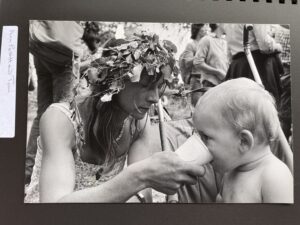
A woman at Greenham Common Peace Camp feeds a baby with a cup. Credit: Maggie Sully’s Archive, Greenham Women Everywhere
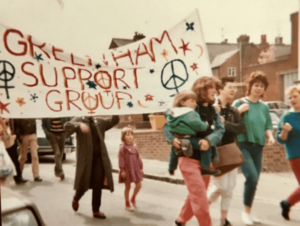
Mothers are a massive part of the founding history of Greenham Common Women’s Peace Camp. It was women and mothers, a few with children in prams, and a handful of men who in 1981 walked all the way from Wales to Greenham Common military base in Berkshire to protest the UK government’s agreement to house nuclear war-headed planes there, placing at the centre of the hostilities between America and Russia. After their 11 day hike, no one from the military command at the base would come out to speak to them so they decided to stay and that became the 20 year land occupation that was Greenham Common Women’s Peace Camp.
Strong themes of motherhood and mothers, their concern and creativity, runs through that 20 years. Mothers and children would come to the fence and leave baby bonnets, photographs, children’s toys; all tied to the military wire that surrounded the camp. There were mothers like mine that visited, gates at the camp like Orange that particularly welcomed families, and there were mothers and children that left their homes and lived at the camp. One baby was born at the camp and some Greenham Women lost custody battles as local authorities sided with estranged and outraged fathers against these radical, unruly mothers.
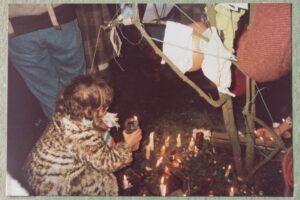
A child lays a candle at a candlelight vigil at Greenham Common Peace Camp. Credit: Illona Linthwaite’s Archive, Greenham Women Everywhere
My mother took me to events like Embrace the Base which was an incredible display of female solidarity to be part of at only five years old. It was the biggest women-led action since suffrage: women and children came from all over the country, over 60,000 of them, and actually held hands around the nine mile perimeter of the base. I can remember being part of the human chain with these amazing women, hearing thousands of women’s voices powerfully lifted in song and being absolutely transported. I recall being struck with the knowledge that one day I too would be a woman and that it seemed like a powerful and positive journey ahead.
The camp more widely was also suffused with images and ideas about Mother Earth: the women weren’t just battling sexism and militarism, they were also looking at the role that we have as children of the Earth and our relationship to the land itself. Getting the Common back into public ownership was a key aim and one of the camp’s great successes – you can go now and see families picnicking, people walking their dogs, cows grazing, all the military buildings given over to local businesses, community cafés and arts centres. At camp, women reconnected with the idea of the divine feminine and how we could all be good children to our providing mother, dialogues about care for the environment that continued from the beginning to the end of Greenham’s history.
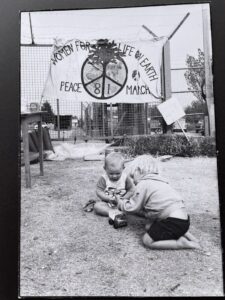
Children play at Greenham Common Peace Camp. Credit: Maggie Sully’s Archive, Greenham Women Everywhere
I’ve been very fortunate to interview a great many Greenham Women in the course of my work and the development of my book Out of the Darkness which has over 50 of their voices coursing through it. Several of those women recount how often people thanked them with the words ‘I’m so glad you’re doing this for our children’. Some confessed to thinking, ‘I’m not doing it for your children. I’m doing it for myself. I’m doing it for my community.’ These women challenged the idea that women should be active for others and not for themselves alone and railed against being tied to obligations to meet the more traditional roles allocated to women. But by taking up such public space, whether living at or visiting the camp, whether as mothers or not, the Greenham Women changed completely the way that women were seen culturally and politically. In the 1980s women were rarely to be seen in public office, in the police or military, as leaders of industry or leads in films and TV; the very fact so many of women campaigned en masse at Greenham from so many backgrounds and countries changed traditional expectations about women. The press were virulent about the women at the camp precisely because they weren’t at home raising families which was considered a clear dereliction of their duty. The cultural differences that we see today were surely aided and speeded along by the thousands of women in this country who spent time in the melting pot of Greenham Common realising that together they could change their personal and political lives and those of the women and girls who came after.
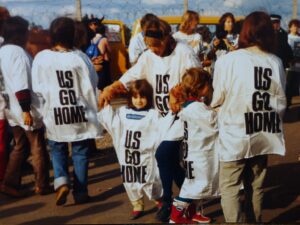
A group of women and children at Greenham Common Peace Camp wearing t-shirts that read ‘US go home’. Credit: Bridget Boudewijn’s Archive, Greenham Women Everywhere
I met a woman recently at an event we held in Wales and interviewed her for a new afterword only available in the paperback addition of Out of the Darkness. We didn’t know when we started talking but it transpired that she had met my mother once at camp and remembered her over 40 years later. They had spoken, whilst carrying a pot of food from Blu gate’s campfire to visiting families at Orange gate, about their very different experiences as mothers. One was a woman from Ireland who, as a lesbian, was at risk of losing her children; she told my mother how desperate and frightened she was about it and remembered that it brought my mum to tears. My mother had the conventional safety of a heterosexual marriage but as a working class northern woman she wanted to see a world for me, her first child, without the constraints and bullying she had received from her male-dominated upbringing. Conversations like these shaped my mother and strengthened her empathy and understanding, and I’m so grateful to her and all the women who I benefited from, growing up as I did in the arms of this incredible camp.
With recent events on the world stage, it feels vital to look to the role of our foremothers at Greenham. The treaties put in place to end the Cold War, in part thanks to the non-violent direct action of the peace women, have expired and look far from being renewed; instead we are seeing the beginning of a terrifying nuclear escalation again.
It couldn’t be more timely not just to look at the amazing things that Greenham Women did but also to look at how they did them – creatively, kindly, bravely, and with great wit and wisdom. This is the upbringing we need now more than ever. I for one pledge to stand by my mam and to say thank you this Mother’s Day to Greenham Women everywhere: we stand on your shoulders to see that a better world is possible.”